Hospitality Insight
How Asia Pacific is defining the future of luxury outdoor lodging
For a long time, luxury was about having more – more layers in the plush bed, more entertainment in the itinerary, more Michelin-starred dinners, more dedicated attention.
The new luxury?
It is more of less, and more of what cannot be bought or owned.
An alluring illusion
It is the alluring illusion of time slowing down, the ability to take extended moments to observe a fleeting sight – a butterfly fluttering through the flowers, an elephant nurturing its young, a local fisherman casting his net in the foreground of a lilac dusk. It is the opportunity to take a few deep breaths while listening to a raging waterfall gush over boulders as old as time. It is the calming and clarifying sensation of hearing one’s own thoughts and feeling one’s own heartbeat.
Asia Pacific is welcoming a generation of luxury outdoor lodging properties in remote locations that offer the discerning traveller access to quiet and unabashedly raw, theatrical nature without compromising on upscale comfort.
Outdoor lodging — the category encompassing luxury tented camps, open-air resorts, eco-lodges, floating villas, and nature-immersive retreats where the environment is integral to the guest experience — is emerging in this part of the world. It is moving from a niche reserved for the adventurous to a defined hospitality category with its own design language, its own economics, and its own competitive logic. In 2024, Asia-Pacific’s outdoor lodging market was valued at approximately USD 620.5 million and is projected to exceed USD 1 billion by 2030. At a compounded annual growth rate of 14–16%, Asia Pacific is the fastest growing region globally. The global outdoor lodging sector was valued at USD 25.8 billion in 2019 and is forecast to reach USD 41.7 billion by 2027.
Behind these numbers is something less quantifiable but more interesting: a generational shift in what luxury travellers believe a rejuvenating vacation should feel like — disconnection from our very wired and, at times, performative lives; an intimate acquaintance and exploration of our natural environment; and through that, a deeper connection with ourselves.
A growing legion of travellers across Southeast Asia and beyond are seeking restoration in preference to traditional cultural and sight-seeing touring. They want to feel the earth beneath their feet, wake to birdsong and the rustling of leaves rather than traffic, and return home genuinely awakened, re-energised and hopeful. For property developers, operators, investors, and lenders paying attention, this is not a lifestyle trend. It is a structural market transformation with outdoor lodging at its core.

Download Report
 From escape to category
For most of the last century, the safari camp was Africa’s invention and export. The tented lodge — canvas walls, raised platform, generator hum at dusk — carried a particular romance that was associated with the Serengeti, the Okavango, and the Maasai Mara. When this accommodation format arrived in Asia, it appeared as a few camps in Rajasthan and a handful of eco-lodges in Borneo and northern Thailand that operated at the intersection of conservation and tourism, though often more committed to the former than commercially fluent in the latter.
One early exception — and the property most widely credited with establishing the luxury tented camp as a distinct category in Asia — was the Four Seasons Tented Camp Golden Triangle, designed by prolific and renowned hotel architect and landscape designer Bill Bensley and opened in 2006 in the Golden Triangle of Chiang Rai province, Thailand. As Four Season’s first all-inclusive jungle experience and its first tented hotel worldwide, the concept was genuinely experimental at the time: a luxury tented experience combining theatrical, architecturally rigorous design with a serious elephant conservation programme in one of Southeast Asia’s most storied border landscapes. It had no clear regional precedent and no guarantee of commercial success. What it demonstrated, however, was that canvas walls and a remote jungle setting could command rates, loyalty, and critical reputation.
What is different now is the ambition. Asia Pacific is home to an extraordinary inventory of landscapes, ecosystems, and cultural contexts that outdoor lodging has barely begun to access. Across Southeast Asia, the Indian subcontinent, and the Pacific, developers and operators are not translating the African safari model but building something native to their respective locations. Properties calibrated to monsoon rhythms, to the specific microclimates of highland valleys and coastal forests, to the cultural and ecological textures of place unique to this region. The result is a category of accommodation that has more in common with each other — in philosophy, operational logic, and guest promise — than with the conventional luxury resort that most of us are familiar with.
Indonesia alone contains more than 17,000 islands. Its rainforests are among the most biodiverse on earth. Its cultural diversity — Balinese Hindu traditions, Javanese craft heritage, the animist traditions of Sumba and Sulawesi — offers design and programming depth that no other region can match at comparable scale. Cambodia’s remaining forested provinces contain ecological corridors that conservation-tourism development could protect and make commercially viable simultaneously. Thailand’s capacity in this category is also underestimated. Beyond the Golden Triangle properties that have drawn international attention such as the Four Seasons Golden Triangle, the country’s northern highlands — Chiang Rai, Mae Hong Son, and the border regions with Myanmar — contain forested landscapes, hill tribe communities, and biodiversity corridors that outdoor lodging has barely touched. Southern Thailand’s Andaman coastline, beyond the established resort clusters of Krabi and Phuket, offers marine and rainforest combinations — limestone karst, mangrove estuaries, small-island ecosystems — that the overwater villa format has not yet addressed with the ecological specificity the sites demand.
The wildlife reserve system in India — anchored by Project Tiger’s network of core and buffer zones — has produced a conservation-lodging model in Madhya Pradesh, Rajasthan, and Uttarakhand that the travellers know through names like Taj Safaris and Sher Bagh but has not yet recognised as a category in its own right. The subcontinent’s ecological diversity is extraordinary: from the mangrove systems of the Sundarbans to the high-altitude meadows of Ladakh, from the tea and spice landscapes of Kerala and Coorg to the grassland corridors of the Terai. Sri Lanka’s tea country and its wildlife reserves — Yala, Wilpattu — are also producing some of the region’s most credible conservation lodging, largely invisible to international media.
Australia occupies a different position in the regional outdoor lodging narrative. Its contribution is less about frontier development and more about mature execution. Properties like Longitude 131° in the Northern Territory and Sal Salis in the Ningaloo Reef have demonstrated — over years of operation — what the category looks like when site-specificity, ecological stewardship, and exceptional hospitality are fully integrated at commercial scale.
Conservation as product design
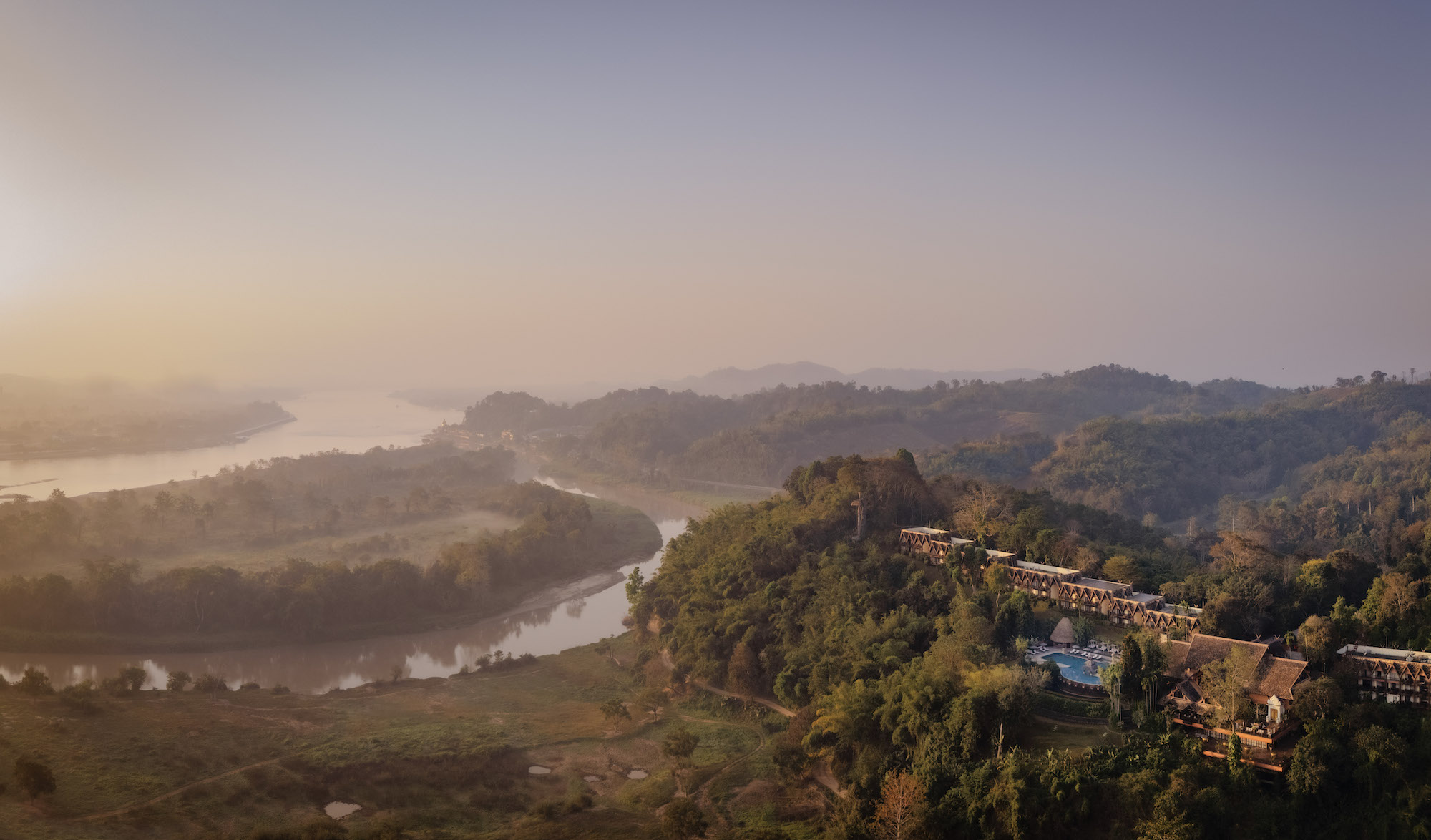
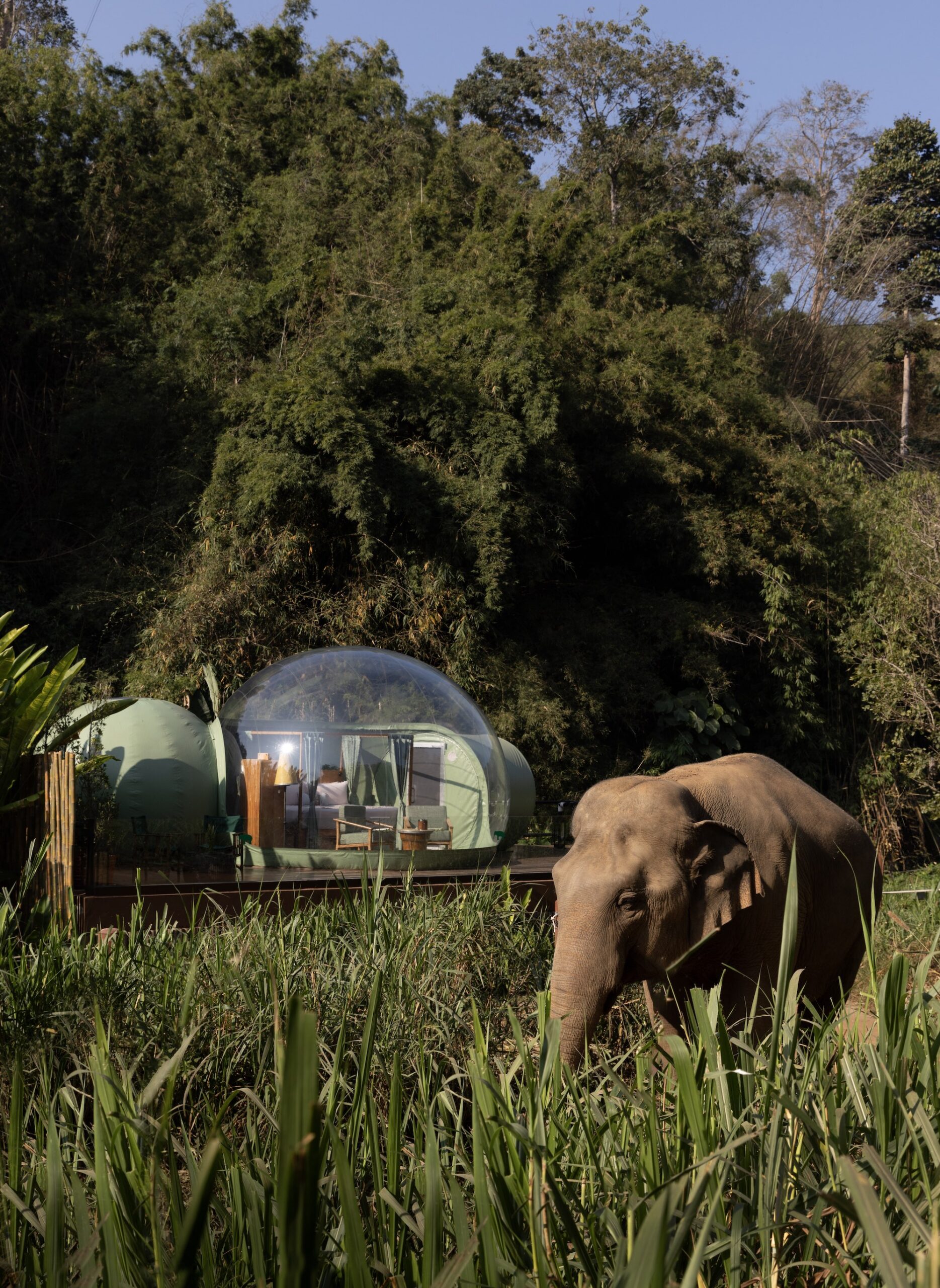
At the meeting point of Thailand, Laos, and Myanmar, Anantara Golden Triangle Elephant Camp & Resort has been hosting guests in its Jungle Bubbles for over a decade: transparent domes set on a hillside above bamboo forest, where the panorama across the Golden Triangle unfolds from bed. The stay experience is theatrical and almost spiritual — sleeping in a bubble and watching elephants move through their natural habitat at dawn. Owned by Minor Group, the resort sits across 160 acres of northern Thai jungle, perched above the confluence of the Mekong and Ruak rivers, roughly 60 kilometres from Chiang Rai International Airport. What has evolved at Anantara Golden Triangle, beyond the bubble itself, is the seriousness with which the elephant programme anchors the entire property’s proposition. The on-site elephant camp, run in partnership with the Golden Triangle Asian Elephant Foundation, houses approximately 17 rescued elephants. The interaction is ethical and educational — no riding, structured observation, and mahout experiences that tell the story of conservation to facilitate understanding than social media fame. The Jungle Bubbles are prefabricated, elevated, and removable, designed to co-exist with the elephant habitat without permanent ground disruption. While the Jungle Bubble is the novel accommodation format, the real draw is the privilege to observe these magnificent, gentle giants in close proximity. With a full year occupancy of 40-50%, ADR of USD1,000-1,200, it is clear that its conservation offering combined with its remote location and creative accommodation format is exactly what travellers are looking for.
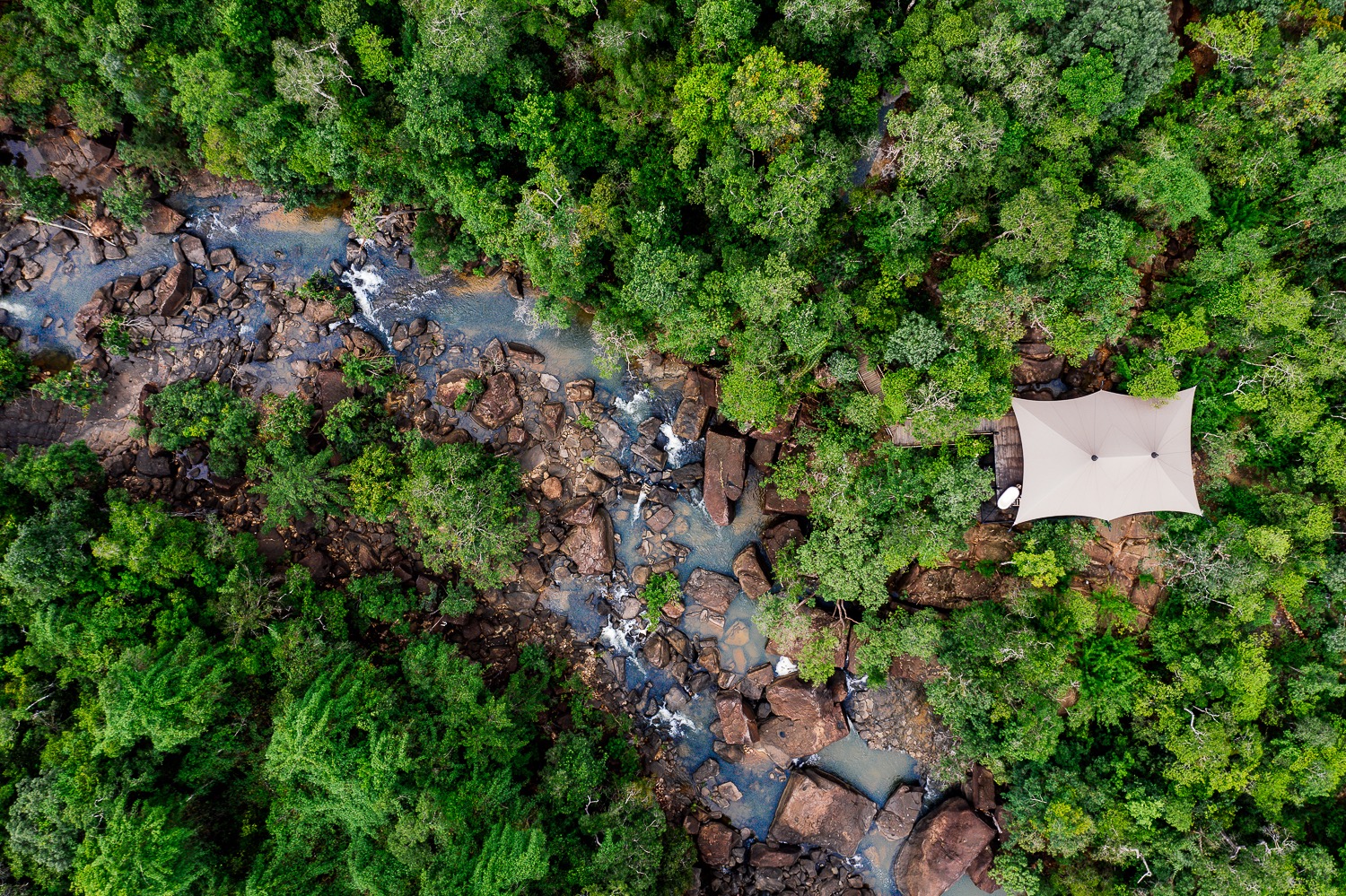
Cardamom Tented Camp , situated within the Botum Sakor protected landscape in Southwest Cambodia, was established in 2017 through a partnership between Wildlife Alliance and YAANA Ventures, operated under VHG Hospitality Asia. The camp’s 12 safari tents are kept deliberately simple — raised platforms, river access and guided treks into protected forest. What guests come for is not luxury in the conventional sense but proximity to something valuable that is disappearing: lowland rainforest, wildlife corridors, and rivers that still run clear. The camp’s armed ranger patrols, funded directly by Wildlife Alliance and supported by guest stays, protect the surrounding concession from poaching and illegal logging. The camp’s entire operational logic is structured around making the conservation work visible, legible, and worth funding. In 2025, the camp was named winner of the ICRT South East Asia Nature Positive Gold Award and a finalist in the ICRT Global Responsible Tourism Awards.
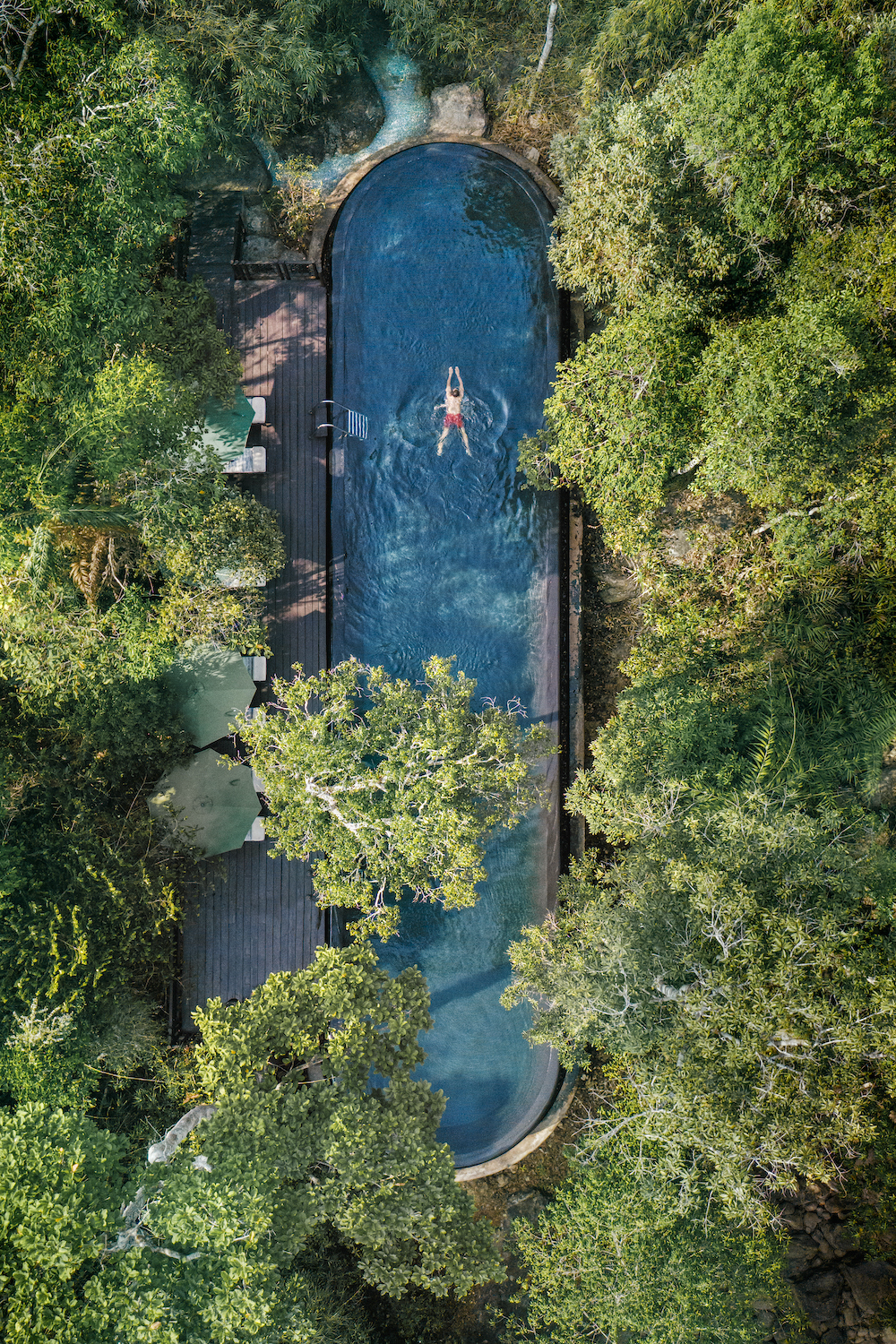
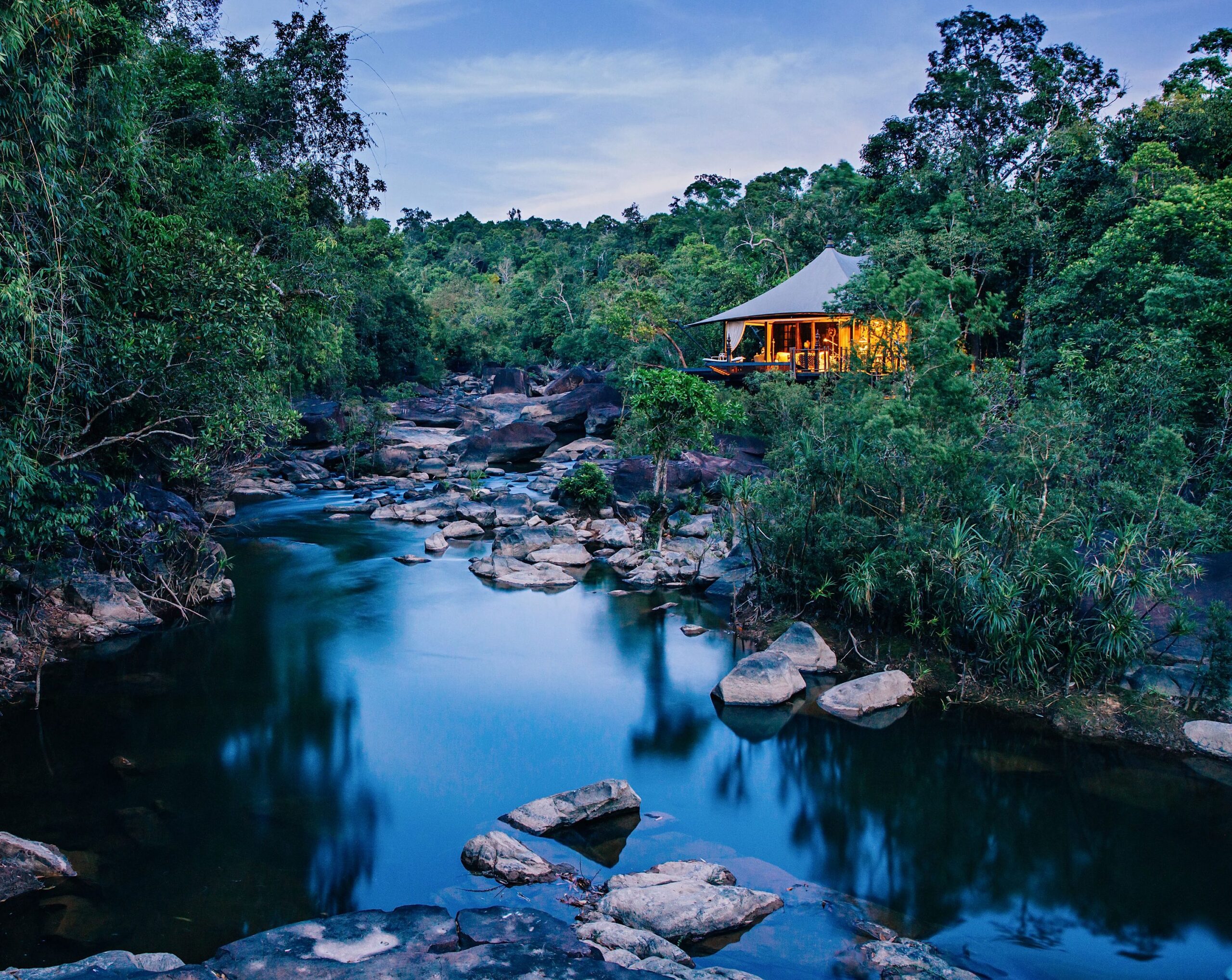
An hour away by river, Shinta Mani WILD , a Bensley Collection property in the South Cardamom rainforest of Cambodia, takes a different approach to the same challenge. Bill Bensley’s signature — wit, extravagance, a refusal to take the “eco-lodge” aesthetic at face value — is everywhere. Described by Bensley as “a utopia of sustainability”, the 15 tents at the property stretch along a 1.5-mile river, sited deliberately so that the property maintains a density of roughly one tent per 66 acres of forest, and not a single tree was felled to build the camp. Guests arrive by zipline from a seven-storey tower, flying 400 metres over forest, river, and waterfall to the Landing Zone Bar. Khmer antiques, design references to King Sihanouk and Jackie Kennedy-Onassis’s 1967 Cambodian travels, and meticulous F&B sit alongside a conservation programme that is making serious impact. Shinta Mani WILD was founded specifically to save 865 acres of rainforest — and 875,000 trees — from a planned titanium mine. The property funds eight Wildlife Alliance rangers around the clock, protecting roughly 2,000 hectares of forest and saving an estimated 500 wild animals annually; to date, the rangers have confiscated more than 2,700 chainsaws. Of Shinta Mani WILD’s 120 staff, 70 percent are hired from the surrounding village; many were previously poachers and loggers themselves. Guests at the property have the option to join anti-poaching patrols with the rangers, which is an eye-opening experience.
In outdoor lodging, the most durable properties are not those with the tallest dome or the most remote tent. It is those that manage to strike a coherence between the format, the place, and the programme.
These properties also prove that credible conservation mission is not a burden on the guest experience but is the guest experience itself. The tension it resolves — how do you deliver spectacular theatre in a functioning, natural ecosystem without hollowing out the authenticity? — is what the entire outdoor lodging category is focused on.
 Where less is more
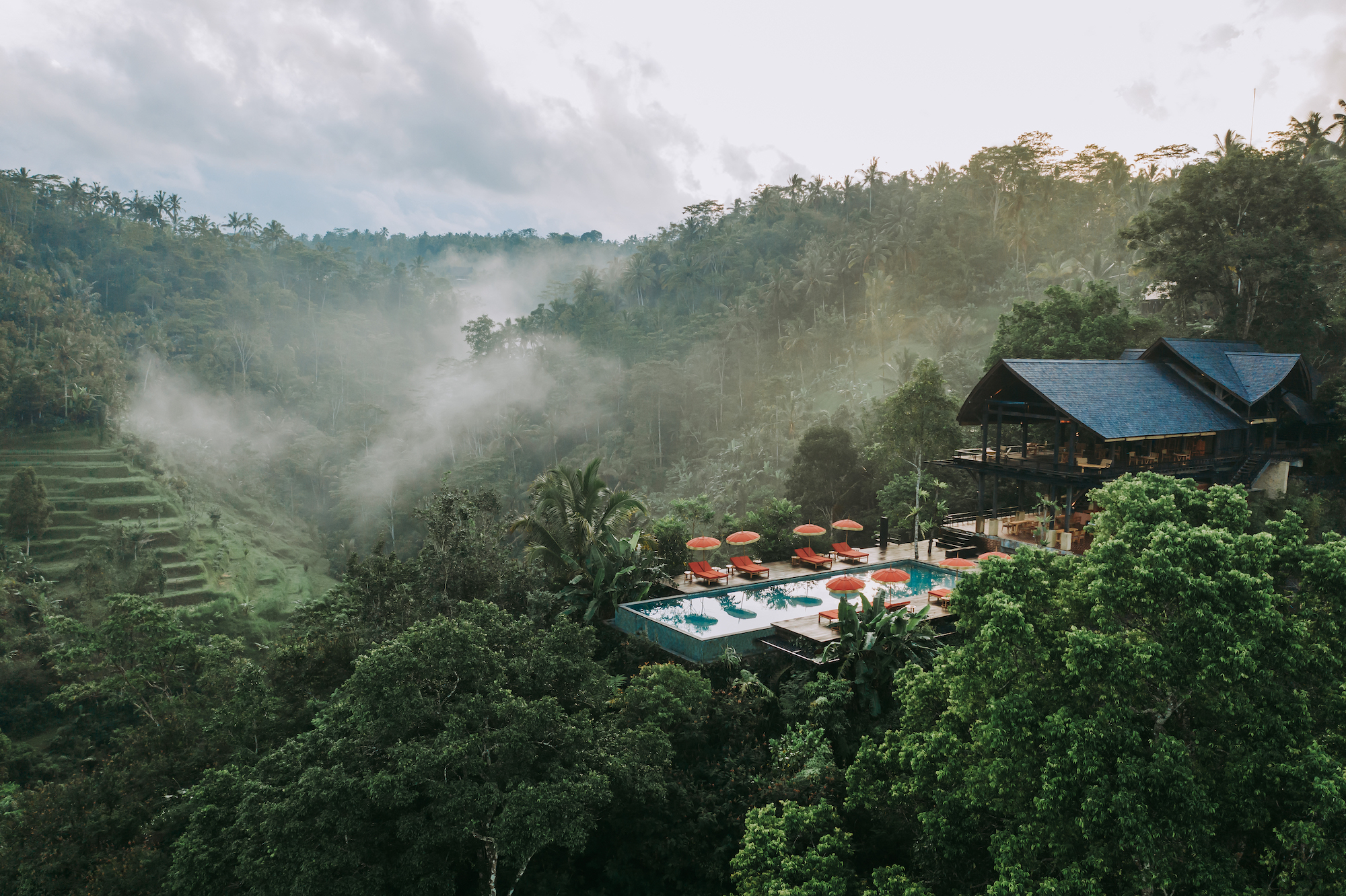
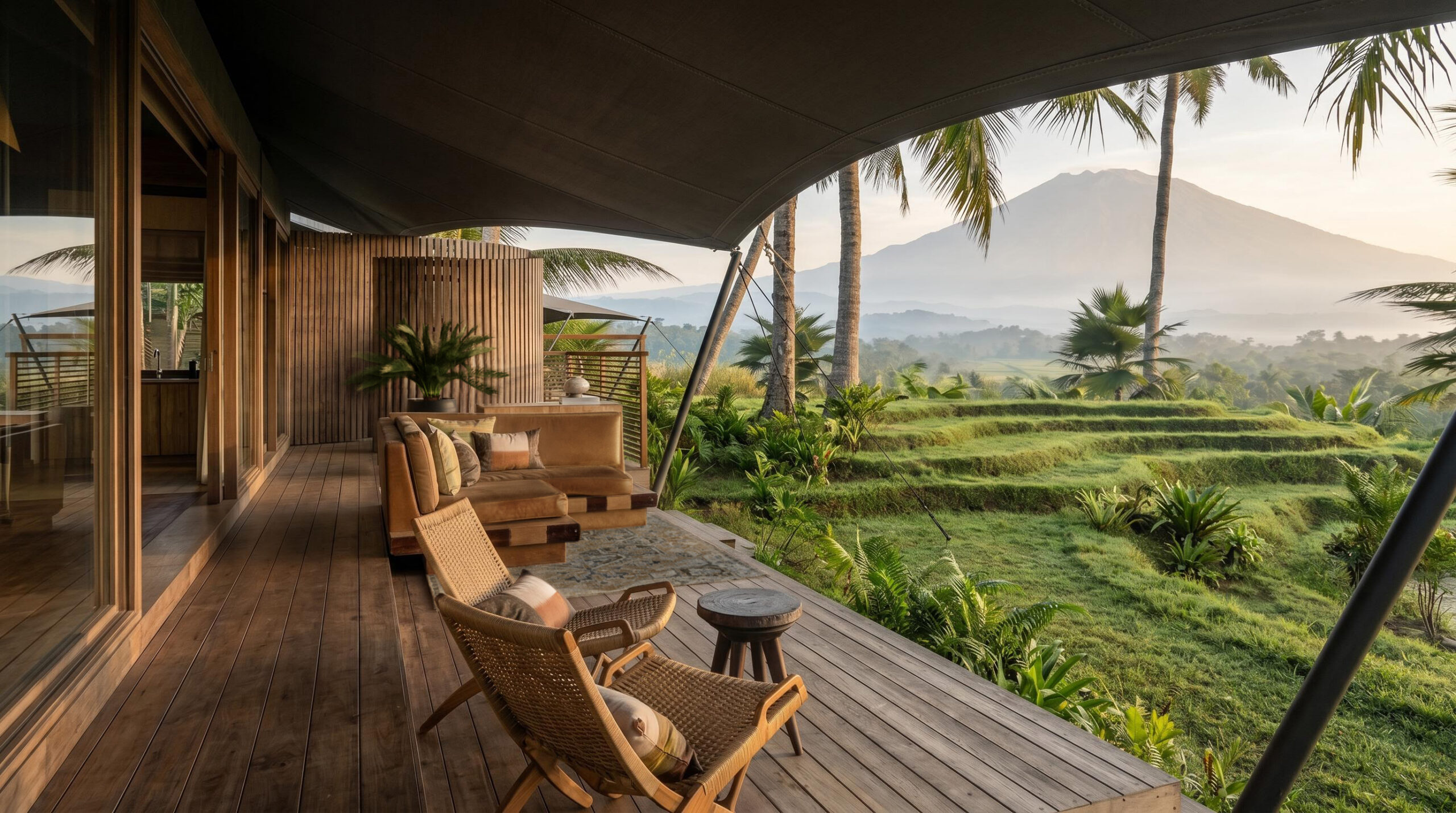
If any single property makes the case for outdoor lodging as a legitimate luxury category rather than an interesting subgenre, it is Buahan – a Banyan Tree Escape by Banyan Group. Opened in May 2022, Buahan is a 16-key open-air resort set across 4.68 hectares in a highland valley north of Ubud, 40 minutes from the tourist circuits of central Bali, Indonesia. The resort, with its “No Walls, No Doors” design philosophy, achieves an average daily rate of USD 700 to 850, occupancy of ~55%, and a gross operating profit margin of 35–40%. Rooms revenue makes up about 72% of total revenue, followed by 18% F&B and 6% spa. For context: a full-service luxury resort achieving those GOP margins with that ADR would be considered a strong performer. Buahan achieves these results with a starkly different infrastructure, talent strategy, and a product concept that conventional hospitality investments would not have funded.
Banyan Group selected the 4.68-hectare parcel in 2001, from more than 20 sites evaluated across the Ubud area. 21 years and 16 design iterations followed – through two Bali bombings, SARS, two financial crises, the Global Financial Crisis-induced construction halt of 2009, and the pandemic. The “No Walls, No Doors” concept itself was not crystallised until 2017; a full-scale prototype was built and tested on-site in 2018 before final commitment was made to the build. Before any design work began in earnest, the development team commissioned ethnographer Gede Kresna of Rumah Intaran to lead a four-month cultural survey within a 30-kilometre radius, mapping 29 villages, 34 temples, ceremonial calendars, seasonal produce cycles, local healers, artisans, and architectural traditions — extensive research that became the foundation of the property’s exclusive guest experience programme. The architectural execution drew on recycled ironwood for major structural elements, copper bathtubs hand-smithed in Boyolali in Central Java, teak furniture from Jepara, and stonework incorporating volcanic ash from Mount Agung. Roughly 80% of operating staff are hired from the surrounding villages of Buahan Kaja, Taro, Payangan, and Gianyar.
To say that this project was a labour of love and dedication would be an understatement. Buahan has demonstrated that low key count and open-air architecture is neither a compromise nor a limitation. On the contrary, the absence of walls and doors enable guests to experience the valley, the river, the morning mist, the sound of the forest, and the fireflies that visit at night in a way that is visceral and unforgettable. Buahan works with Netherlands-headquartered Evening Breeze, an energy-efficient, eco-sensitive climate control system that creates a cooled, temperature controlled microclimate directly around the bed. These design and philosophical decisions, made with rigour and patience, produce a product that is highly unique.
The draw of the wilderness
In Southeast Asia, outdoor lodging properties have largely been developed and invested by founders and private capital. Australia, on the other hand, is where the same category is being built through institutional infrastructure.
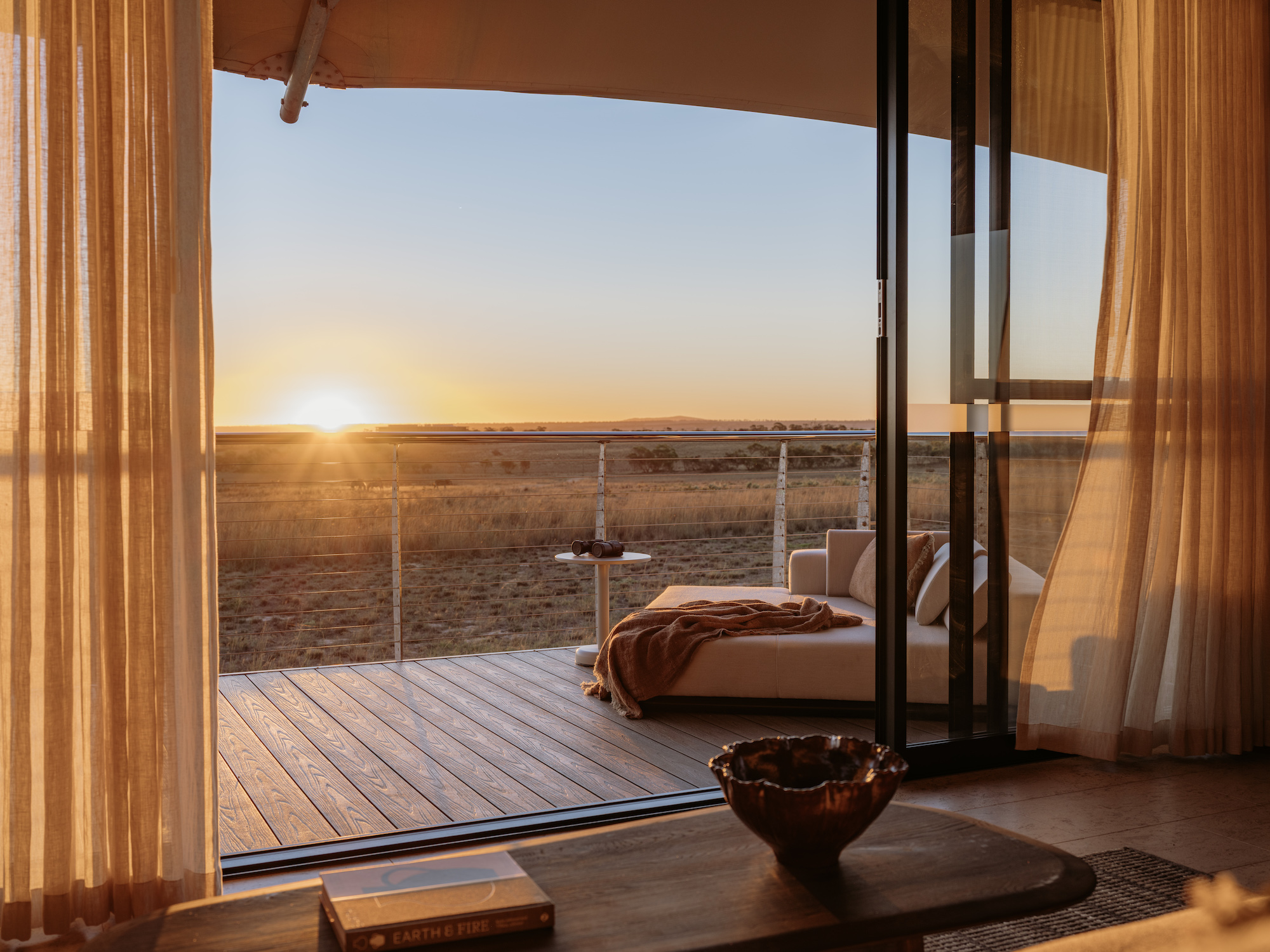
Wilderluxe , launched in January 2025 by Reflections Holidays, is a portfolio play. Reflections — the NSW Crown Land manager that operates 40 holiday parks and 47 community reserves, and the only Australian holiday group certified as a social enterprise — is rolling out 5 “barefoot luxury” glamping retreats across New South Wales by the end of 2026. Opened in April 2025 in Big Sky Country between Tamworth and Gunnedah, Wilderluxe Lake Keepit is the first retreat and is supported by a NSW Government Regional Tourism Activation Fund grant. Featuring 8 Hybrid Star Gazer Tents with integrated bath pods custom-designed by Australia-headquartered Eco Structures, each tent is positioned to capture uninterrupted views of the lake and expansive night sky. Properties follow at Lennox Head, Eden, Brunswick Heads, and Lake Glenbawn — coast and country pockets within an hour’s flight of Sydney.
Monarto Safari Resort , in South Australia’s Murraylands an hour from Adelaide, is the operator-platform expression of the same shift. Owned by Gerry Ryan AO and operated by Journey Beyond — the Adelaide-headquartered experiential tourism group whose 20 brands include the iconic train The Ghan, the Indian Pacific, and the eco-luxury Sal Salis Ningaloo Reef — the resort opened in May 2025 with 78 hotel rooms adjacent to Monarto Safari Park’s 550-hectare Wild Africa precinct. It welcomed 19,000 guests in its first year and was named Best New Tourism Business at the 2025 SA Tourism Awards. Its Safari Lodge extension, opening 2 April 2026, adds 20 all-inclusive luxury safari tents with private decks fronting the waterhole. A portion of every stay is donated to Zoos South Australia’s conservation programmes — including the Wild Africa species the resort is built around.
What links these two properties is that neither required the developer to be the conservationist, the marketer, the platform, and the investor. State tourism funding and a 20-brand experiential operating platform absorb different parts of the load. Such developments in Australia provide proof points that outdoor lodging can travel through institutional investment and operational infrastructure without losing product integrity.
 The next wave
Several new and exciting developments are preparing to welcome guests and these developments are worth watching. Aside from creative product offerings, these developments signal a growing trend of investment in luxury outdoor lodging, how global brands are entering the category, and tests how this emerging category will integrate into global distribution frameworks.
ROAM. A new active adventure and wellness brand from Cloud Collective — the same global outdoor hospitality group behind KAIA, which is opening its first property in Koh Phangan, Thailand in 2026 — ROAM is built for a generation of travellers who move through the world with curiosity: in the water at dawn, around a long table by evening, as likely to be surfers or trail runners as design-aware urbanites seeking a different kind of reset. Its camps and retreats are sited in wild, deeply rooted destinations where the terrain shapes the programme, and where good company, thoughtfully sourced food, adventure and genuine recovery are central to the stay. ROAM’s first property opens on Bali’s east coast in 2028 — a stretch of black sand far from the island’s established tourism circuits — with a pipeline extending to Japan, Australia, Sri Lanka, and southern Europe.
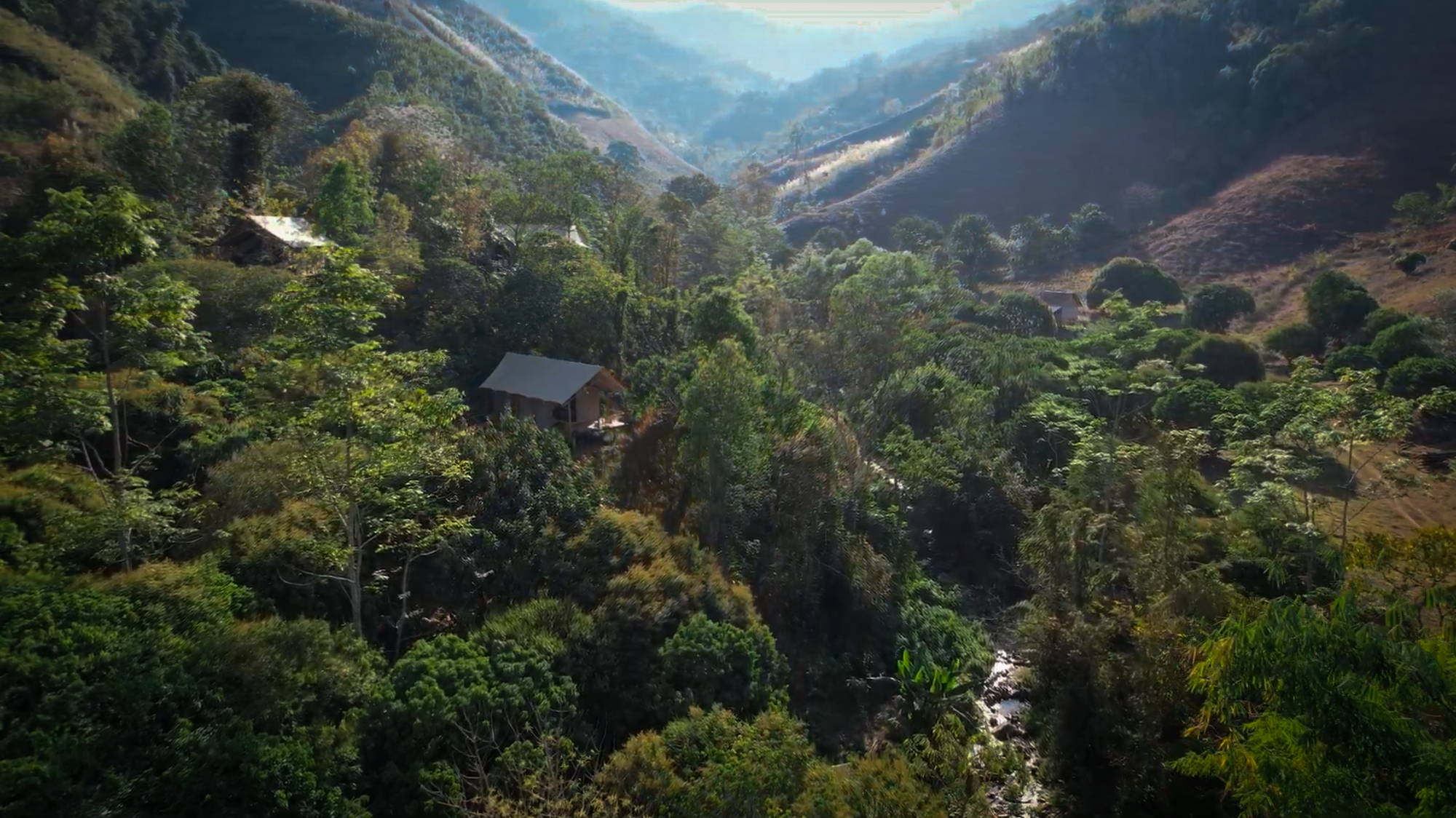
Visama Luxury Tented Camps. YAANA Ventures’ Visama is in active expansion across Southeast Asia after its Visama Opportunity Fund closed in December 2024. The flagship Visama Reserve sub-brand is calibrated at 20 to 24 keys, with every Reserve property positioned within one hour’s drive of a regional airport — removing the remoteness penalty that typically suppresses occupancy for more inaccessible outdoor lodging sites. Visama Explorer Nan opened in northern Thailand in early 2026 as the first fully operational property; a Cambodia project in Preah Vihear province has a 2026 soft opening target, with further sites in Nepal and Sri Lanka under exploration. The bet is that site-specificity, managed rigorously across a portfolio, is itself the competitive moat.
Emirates Wolgan Valley, a Ritz-Carlton Lodge. Opening mid-2026 in the Greater Blue Mountains UNESCO World Heritage area of New South Wales, Australia, Wolgan Valley is a 40-key all-inclusive lodge sitting within a 7,000-acre conservancy and marks the global debut of Ritz-Carlton Lodge — a new sub-brand within The Ritz-Carlton portfolio joining Ritz-Carlton Reserve and The Ritz-Carlton Yacht Collection. The lodge occupies less than two percent of the protected wilderness. Emirates invested AU$150 million in the property from 2006, planting more than a million native trees and restoring an 1832 homestead, before committing a further AU$50 million in renovations in partnership with Marriott. Designed and planned by CHADA, local artisans, such as blacksmiths and stained-glass window makers were employed to give the buildings authentic Australian character, and interior colour schemes draw inspiration from the local bushland. When one of the world’s most established luxury hotel brands creates a dedicated outdoor lodging sub-brand and launches it from Australia, it confirms the category’s arrival — but also raises the question of how the defining attributes of outdoor lodging will fare as global brands enter at scale.
In September 2025, Marriott launched the Outdoor Collection by Marriott Bonvoy as its 33rd brand and its first dedicated to outdoor-immersive lodging. Inaugural members are Postcard Cabins — the operator of more than 1,200 design-forward cabins across 29 U.S. locations that Marriott acquired in 2024 — and Trailborn Hotels, with properties at destinations including the Grand Canyon and the Blue Ridge Mountains. The accompanying Marriott Bonvoy Outdoors digital platform aggregates more than 450 outdoor-focused hotels worldwide, 50,000 Homes & Villas, and curated tours and activities. Marriott has signalled that future Outdoor Collection additions will include yurts, domes, ecolodges, and “other unique escapes.”
While the entry of global platforms into outdoor lodging may indicate the category’s commercial maturity, its future character, however, is less likely to be brand scale than the continued emergence of properties that are genuinely site-specific, conservation-credible, and difficult to replicate — qualities that the independent operators and visionary developers who pioneered this category have established.
 Defining principles of Outdoor Lodging
Across these properties — from the Cardamom Mountains to the Gulf of Thailand, from the highlands of Bali to the wilderness of New South Wales — several patterns emerge that describe not just individual success stories but the architecture of a category.
The site is the product.
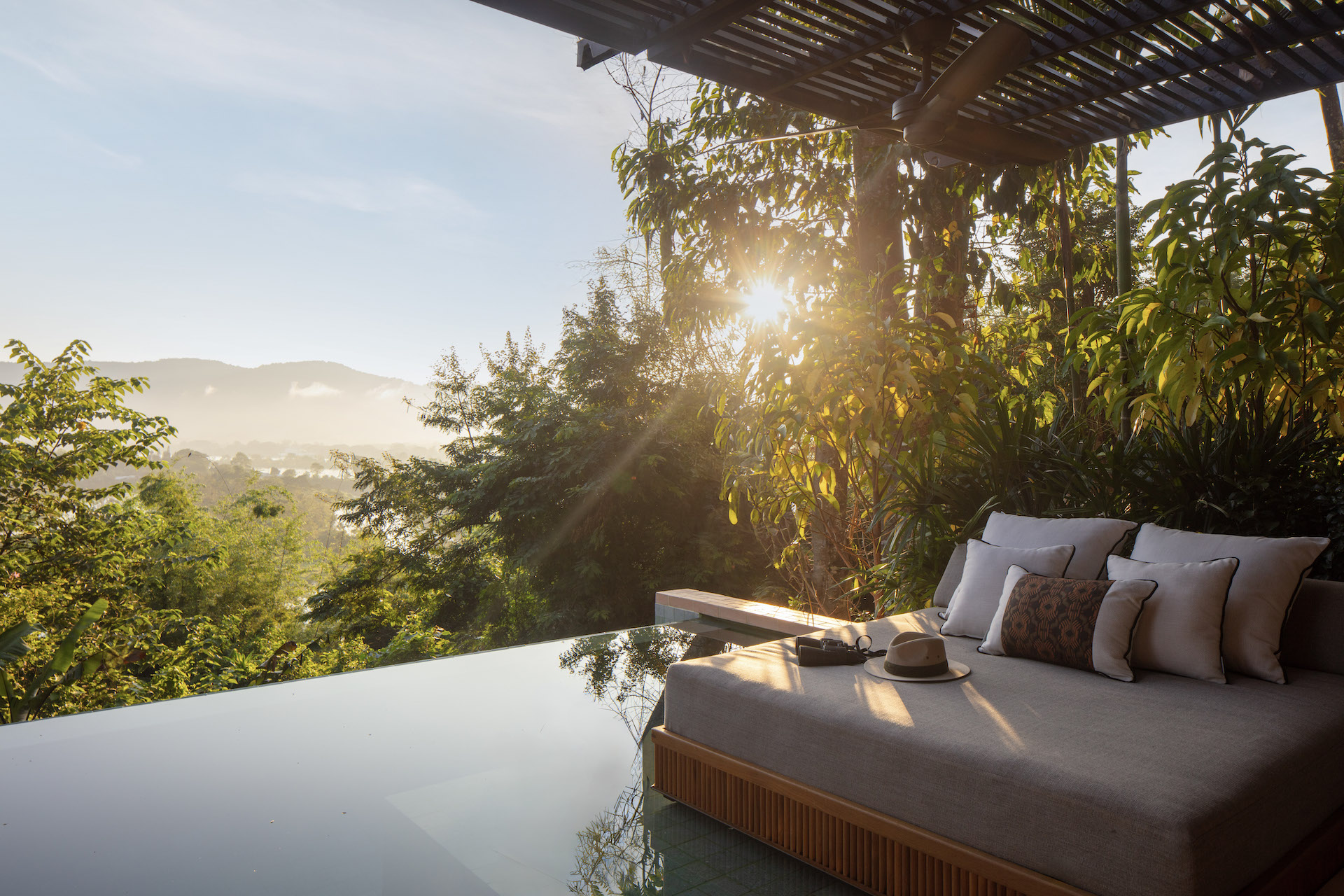
In conventional hospitality development, the site is a consideration to be managed: how to maximise key count, minimise land disruption, optimise revenues, meetings space and F&B covers. In outdoor lodging, the site is the star and the brief. Topography, ecosystem, microclimate, community and cultural landscape are the exact reasons why guests choose the property and pay premium rates. This goes beyond the usual site analysis, requiring far deeper understanding of the land and its multi-dimensional context.
Low key count is a pricing strategy.
The strongest outdoor lodging properties in Asia-Pacific operate at 12 to 30 keys. In most cases, more keys would be financially straightforward and would make investments more compelling. However. the experience proposition depends significantly on a guest-to-nature ratio that higher key counts destroy. Luxury in this category can only be conveyed through fewer keys, which justifies higher rates and GOP margins.
Conservation is a commercial asset.
This is perhaps the most important structural shift the category has galvanised. The properties performing best — financially and reputationally — are those, like the Anantara Golden Triangle Elephant Camp and the Cardamom Tented Camp, where the conservation mission is structurally integrated into the product: what you do (or not do) while you are there, what you fund by being there, what you understand about the place and yourself when you leave. In a hospitality market saturated with sustainability claims, the integrity of these properties stand out; the ethical credibility is the product differentiator.
Community integration is smart business, not philanthropy.
Outdoor lodging, developed with genuine local partnership, can be a powerful tool for rural economic development and visitor dispersion. Local employment, supply chain integration with nearby farms and artisans, conservation and education of local traditions, and the channelling of conservation fees back into habitat protection create a virtuous cycle in which the project’s commercial success and the community’s wellbeing are aligned. Guests are perceptive, and they reward authenticity. A property visibly woven into its local community and landscape commands a loyalty both from guests and the local environment.
Complexity is the moat.
Outdoor lodging development is not simple. Infrastructure investment in remote or semi-remote locations can be substantial — reliable power, water management, waste systems, and access roads often built from scratch. Permit approvals in environmentally sensitive areas is appropriately rigorous, and navigating local regulatory frameworks requires patience, local expertise, and an authentic commitment to environmental stewardship. Properties done well — thoughtfully designed, responsibly built, and intelligently operated — achieve pricing power and occupancy resilience conventional hotels cannot match. Investors who commit the time and capital to execute properly are rewarded not just with attractive yields, but with assets that are difficult to replicate and appreciate accordingly.
All-inclusive pricing is a logical fit.
The operational characteristic of outdoor lodging — remote or semi-remote settings, limited nearby dining alternatives, and a programme built around guided nature activities, ranger-led excursions, and conservation experiences — makes all-inclusive pricing a coherent and commercially sound choice. Properties such as Shina Mani WILD in Cambodia, Monarto Safari Resort in South Australia and Emirates Wolgan Valley in New South Wales have already adopted full-board or all-inclusive structures, simplifying the guest decision and removing the friction of itemised billing. At low key counts, bundled pricing creates revenue certainty, simplifies provisioning and staffing, and enables the property to deliver a consistently curated experience from arrival to departure. For guests paying a premium for setting and programme, the all-inclusive model aligns incentives: the property is motivated to ensure every activity and meal delivers quality, and the guest is motivated to engage fully rather than weighing the cost of each experience.
Brand extensions are the next test.
Several of the world’s major luxury hotel brands are watching outdoor lodging with careful attention. Banyan Group’s Escape brand extension, with Buahan as its founding case study, has four properties in pipeline: Ubuyu in Tanzania (August 2026), Sian Ka’an in Mexico (December 2026), Balak in Indonesia (2027), and El Nido in the Philippines (timing to be confirmed). Opened in April 2026, Anantara Tented Camp Kafue River is an ultra-luxury safari retreat located in Zambia’s Kafue National Park. Consists of only 13 highly exclusive keys designed by South Africa’s MRS Studio, the camp is elevated 3.5 metres to canopy height on rosewood timber platforms and lightweight structures, protecting seasonal water flow and allowing wildlife to move unhindered beneath. Other groups are in exploratory conversations that have not yet become public commitments. Every successful outdoor lodging property is, in some essential way, untransferable. The challenge for brand extensions is to develop principles rigorous enough to produce quality consistently without prescribing the site-specificity on which quality depends.
Today’s discerning luxury travellers are won by emotional irreproducibility. Well-executed outdoor lodging properties consistently demonstrate that guests spend more per night, stay longer, and return more frequently. The reason is emotional: these properties deliver an experience that is personal and highly unique. When a guest watches the sun set over a forest canopy from a private deck, they are not consuming a commodity — they are experiencing an irreproducible moment. That emotional resonance translates directly into RevPAR premiums, strong direct booking rates, and word-of-mouth marketing.
 Into the wild and Into the world
What started as a handful of safari-influenced camps on the edges of Asia Pacific’s protected areas is now a defined category — one with its own design language, its own investment thesis, and its own expanding footprint of global brand participation. The journey from curiosity to category has been gradual and uneven, shaped largely by visionaries willing to spend decades refining a concept, operators willing to build roads to unknown places, and guests willing to swap the infinity pool for a river at dawn.
The numbers tell part of the story: A 14-16% CAGR in Asia Pacific, USD 1 billion market by 2030, significant RevPAR premiums, and GOP margins that outperform more capital-intensive properties. But the more compelling narrative is emotive — it is in the pristine forest at 5 a.m., when the mist is still in the canopy and the only sound is water moving over stone. It is in the guest who arrived exhausted and departs refreshed. It is in the 120 staff members at Shinta Mani WILD, who now protect the forest they used to log. It is in the million trees planted at Wolgan Valley, reclaiming a landscape that had long been degraded.
Asia Pacific is uniquely positioned to lead this category. Nowhere else on earth combines such vast ecological diversity — from the monsoon forests of the Cardamoms to the tidal flats of the Sundarbans, from the karst coastlines of southern Thailand to the high-altitude meadows of Ladakh — with cultural depth, development momentum, and a new generation of operators and investors who understand that the land is not merely a backdrop but the raison d’etre.
For developers, the opportunity lies in patience: to find the right site, hold it with conviction, and resist the temptation to add more keys. For operators, it is in the discipline: to build a programme coherent enough that guests leave with a greater understanding for the land, the environment and the community. For investors, it is in the recognition that complexity is the moat — well-designed properties in places worth protecting and with communities authentically involved, generate returns and loyalties that outperform conventional resort properties. And finally for the rest of us, the outdoor lodging category reminds us why many of us got into the hospitality and tourism industry in the first place: to protect beautiful spaces and create unforgettable, irreproducible moments and memories for travellers and guests.
The tent is pitched, the bonfire is lit and the wilderness is waiting. And for those who understand what outdoor lodging can become — and what it can protect — the most extraordinary chapter is still ahead.
How we can help
Horwath HTL has established itself as a leading analytical voice in the rapidly expanding luxury outdoor lodging market across the Asia Pacific. Rather than viewing outdoor accommodations as a mere lifestyle trend, Horwath HTL approaches the sector as a structural market transformation with its own unique economics, design language, and competitive logic. Their expertise is rooted in deep, collaborative research, such as their involvement in the Asia Pacific Outdoor Lodging Association (APOLA) August 2025 industry primer, “Outdoor Lodging in Asia Pacific: Seeing the Forest and the Trees”. Furthermore, Horwath HTL collaborates on extensive financial and operational case studies – such as examining the 21-year development and 35–40% Gross Operating Profit margins of Buahan, a Banyan Tree Escape – providing investors and developers with critical data on remote infrastructure and open-air hospitality.
Ho Shyn Yee, Director and Technology Practice Lead, Pacific Asia
| As a Director at Horwath HTL, Ho Shyn Yee specializes in the strategic and commercial frameworks of the luxury outdoor lodging industry. Her work breaks down the complex mechanics of how properties in remote, environmentally sensitive locations command premium rates and occupancy resilience. |  |