Market Insight
A new exchange rate reality
Currency realignment and the future of hotel profitability in Hungary
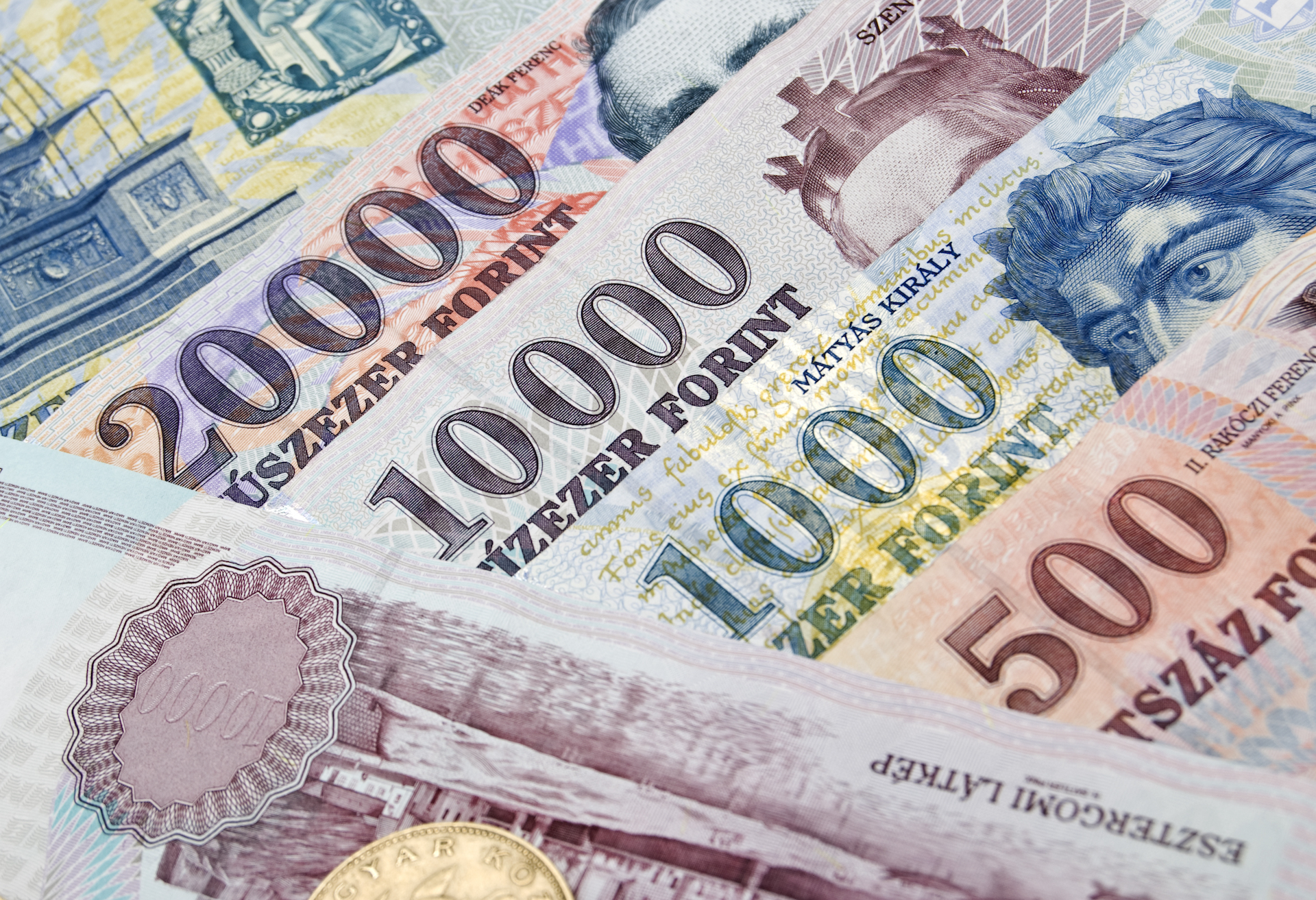
Following the 12 April 2026 general election, in which Péter Magyar’s Tisza party swept Viktor Orbán’s Fidesz from office after sixteen years in power, the Hungarian forint has staged one of its sharpest and most sustained rallies in over two decades.
The EUR/HUF exchange rate — the number of forints required to buy one euro — has moved from around 395–400 in the first quarter of 2026 to the mid-350s by late June: an appreciation of roughly 10–15% depending on the reference point, taking the forint to its strongest level against the euro in nearly five years
Executive Summary
Following Tisza’s victory in the 12 April 2026 election, the forint strengthened sharply, with EUR/HUF falling from around 395–400 in early 2026 to the mid-350s by late June. This 10–15% appreciation took the currency to its strongest level against the euro in nearly five years.
For most of the Hungarian economy this is, on balance, welcome news: it is already lowering inflation, easing the cost of imports and reducing government borrowing costs. For hospitality, it lands very differently. A Hungarian hotel earns much of its revenue against an implicit or explicit euro benchmark while paying almost all of its costs in forint. When the forint strengthens, that gap widens automatically, without a single guest, room or contract changing hands. This article sets out what has happened so far, why the government’s own economic strategy suggests this is a structural shift rather than a passing cycle, what happened when Switzerland and the Czech Republic lived through comparable currency re-ratings, and what Hungarian hoteliers can do about it — while being candid about the parts of this story that are not really optional.

Frequently Asked Questions
Why does a stronger forint negatively impact Hungarian hotels?
Hungarian hotels face a structural currency mismatch. While a significant portion of their revenue is anchored to or negotiated in euros (such as international OTA listings, corporate contracts, and MICE groups), nearly all of their operational costs—including payroll, energy, and domestic food and beverage sourcing—are paid in Hungarian forints. When the forint appreciates against the euro, hotels receive fewer forints for the same euro-priced bookings, which compresses their operating margins.
How much has the Hungarian forint appreciated recently?
Following the April 2026 general election, the EUR/HUF exchange rate moved from around 395–400 in the first quarter of the year down to the mid-350s by late June. Depending on the exact reference point, this represents a sharp and rapid currency appreciation of roughly 10% to 15%, bringing the forint to its strongest level against the euro in nearly five years.
Is this currency shift temporary or permanent?
Evidence points to this being a structural shift rather than a temporary cycle. The new government has explicitly committed to a euro-convergence strategy, targeting compliance with the Maastricht criteria by 2030 and shifting the country away from an economic model that relies on a weak currency. Therefore, hospitality businesses should not build long-term plans assuming the exchange rate will return to the 390–410 ranges seen in 2023–2025.
Are all hotel segments in Hungary being affected equally?
No, a two-speed hotel market is emerging. Budapest and properties with internationally diversified feeder markets are showing resilience because their growth is driven by value-based pricing and guests traveling from further away who are less sensitive to regional currency comparisons. Conversely, domestic and regional leisure destinations (such as Lake Balaton) face direct pressure because their clientele is highly price-sensitive and prone to cross-border price comparisons.
What historical lessons can hoteliers learn from Switzerland and the Czech Republic?
Switzerland’s sudden 2015 “franc shock” showed that destinations and properties that fared best were those that moved upmarket on quality and diversified their guest base, rather than trying to cut rates to defend volume. The Czech Republic’s transition between 2013 and 2017 proved that advance warning and a managed transition convert an existential currency shock into a manageable planning problem.
What immediate actions should Hungarian hoteliers take?
Hoteliers should focus on repricing for value rather than volume, diversifying their target feeder markets away from highly currency-sensitive regions, and stress-testing their P&Ls against multiple exchange rate scenarios (ranging from 330 to 390 EUR/HUF). Additionally, they should look into reducing the lag between cost inflation and rate realization by utilizing euro-referenced or index-linked contract terms, and treat labor efficiency as a critical bottleneck by investing in multi-skilling and technology.
Why a stronger Forint hits hotels harder than most sectors
Currency appreciation does not affect every business the same way, and hospitality sits close to the worst end of the spectrum. The reason is a structural mismatch between where hotel revenue is anchored and where hotel costs are actually incurred.
On the revenue side, a large and growing share of Hungarian hotel demand is priced with direct or indirect reference to the euro: rates loaded onto international OTAs and wholesalers, corporate and MICE contracts negotiated in EUR, and — just as importantly — the instinctive mental comparison every international guest makes against Vienna, Prague, Zagreb or the Adriatic coast in their own currency terms. On the cost side, the picture is almost entirely domestic: payroll (a hotel’s largest single cost line, and now under additional pressure from 2026’s 11% statutory minimum wage increase), energy, food and beverage sourcing, maintenance, and local taxes and fees are overwhelmingly forint-denominated.
When the forint strengthens, nothing needs to change contractually for margins to move. The same euro-denominated booking converts into fewer forints at the point the hotel actually settles its bills, while nominal HUF costs keep rising regardless. GKI Gazdaságkutató’s June 2026 survey of 1,356 Hungarian companies quantifies exactly this effect: internationally exposed service businesses reported an average profitability impact of –15 on a –100/+100 scale. GKI calculates that the forint’s 2026 appreciation alone has added 5–6% to costs measured in euro terms, and that once wage growth and other cost inflation are layered on top, the total euro-denominated cost increase facing internationally exposed service businesses — a category that includes much of Hungarian hospitality — reaches 10–11% for the year. Unless euro-referenced price levels rise by a comparable amount, that gap comes straight out of operating margin.
What has happened so far
The scale of the move: EUR/HUF has fallen from close to 400 in the weeks before the election to a low of around 345–350 in mid-June 2026 — a level not seen since before Russia’s full-scale invasion of Ukraine in February 2022 — before settling in the mid-350s by month-end. Multiple independent readings converge on a similar order of magnitude: the Hungarian Hotel and Restaurant Association describes the forint as roughly 7% stronger since the April election and Hungarian households’ money as worth 14–15% more in euro terms than a year earlier; the European Commission’s spring forecast attributes a 7% currency appreciation to 2026 alone; GKI puts the move at 7.3% over the trailing eleven months.
Resilient Demand Meets a Tightening Labour Market.
Budapest and the internationally diversified segment are, so far, absorbing the shock from a position of underlying strength. 2025 was a record year for the capital by both guest nights (9.83 million) and airport traffic (19.6 million passengers), and Horwath HTL’s own tracking showed Budapest RevPAR up 23.3% year-on-year in the first quarter of 2025. Importantly, that growth is increasingly a story of rate rather than volume — a deliberate shift toward value-based pricing that reflects the need to offset rising operating costs, not simply strong demand doing the work on its own. CoStar data for the first eleven months of 2025 show Budapest occupancy of 72.7%, still below the 78.4% recorded in the same period of 2019, alongside ADR and RevPAR both running well ahead of 2019 in nominal HUF terms. Feeder-market diversification provides some genuine insulation, since guests travelling from further afield are typically less prone to the instinctive euro-comparison shopping that drives price sensitivity among European visitors.
The labour side compounds the pressure as the government suspended new work permits for third-country seasonal workers — a route that had brought staff from the Philippines to many hotels in recent summers — with effect from 6 June 2026, tightening an already seasonal, stretched labour market just as the currency squeeze intensified.
Policy, not accident: Hungary’s Euro-convergence strategy
The scale and persistence of the forint’s move only makes sense considering what the new government is actually trying to do, because this is likely not a speculative overshoot waiting to be arbitraged away. The new government has committed to meeting the Maastricht convergence criteria by 2030, with euro adoption realistically following in 2031–2033. The new government intends to end the “labour-intensive approach that relied on a weakening currency” as a growth model. A stronger, steadier forint is the objective, not an unintended side-effect of the political transition. The practical implication for hospitality planning is important as treating today’s rate as a temporary anomaly that will revert to the 390–400+ environment of 2023–2025 is very likely the wrong assumption to build a business plan around.
How long until it gets better? Three scenarios to 2030
“Better,” in the sense of a return to the weak-forint conditions that underpinned Hungarian hospitality’s price competitiveness for much of the past decade, is not the way analysts covering this transition are framing the next several years. It is more useful to think in scenarios than in a single forecast, not least because credible professional forecasters currently disagree even on direction: Commerzbank expects EUR/HUF to trade in a stable 355–360 band through the rest of 2026 even as rate cuts continue, while other forecasts made only weeks earlier had anticipated a rebound toward 400–410 — a call the market has already run well past.
Scenario one, managed normalisation, is closest to current market pricing: the National Bank of Hungary continues cutting rates toward roughly 5% by the end of 2026, some carry-trade unwind pulls EUR/HUF back into the 360–380 range, and fiscal consolidation proceeds but more slowly than the 2030 target implies. Under this path, hotels face a euro-cost base that is durably 8–10% higher than in 2023–24, but not one that keeps deteriorating.
Scenario two, sustained or deepening strength, follows if EU funds are unlocked on schedule — a deadline of August 2026 has been cited for the bulk of the withheld amount — reform delivery remains credible, and preparatory steps toward ERM II entry begin ahead of schedule. EUR/HUF could hold in the low-to-mid 300s or strengthen further. This is the most demanding scenario operationally for currency-exposed, price-anchored segments, but also the one most consistent with a genuinely improving investment and financing climate.
Scenario three, fiscal slippage, reflects a tension Kármán himself has acknowledged: the government has promised both tax cuts and increased spending alongside deficit consolidation to well below 3% of GDP. If that combination proves politically unsustainable, or EU fund disbursement disappoints against the August 2026 deadline, some of the currency’s political-risk-premium gains could partially unwind, pulling EUR/HUF back toward 380–390. Even this scenario, however, falls well short of a full return to the previous era forint weakness, which would require a genuine reversal of the reform programme rather than a bumpier path along it.
Regardless of which scenario materialises, any hotel budgeting on a return to the 390–410 forint range of 2023–25 is effectively assuming the new government’s reform programme fails outright. That remains possible — but it is not what the market is pricing, and it is not a planning assumption that can be held passively.
Lessons from elsewhere: Switzerland and the Czech Republic
Hungary is not the first European destination to face a currency re-rating that undercuts a hospitality sector’s price positioning overnight.
Switzerland’s 2015 franc shock is the starkest precedent. On 15 January 2015 the Swiss National Bank abandoned, without warning, the floor of CHF 1.20 per euro it had defended for over three years. The franc appreciated by roughly 15–20% against the euro within minutes, briefly trading below parity. Swiss exports became 10–15% more expensive than European competitors overnight, GDP growth fell from 2% in 2014 to just 0.8% in 2015 — Switzerland narrowly avoided recession — and hotel overnight stays fell and kept falling into 2016, with foreign overnight stays down a further 1.5% that year even as domestic demand posted its fourth consecutive annual increase. The recovery, when it came, was sharply uneven by geography and segment in a pattern Hungary should recognise: UBS’s own assessment concluded that tourism and retail in the most exposed holiday regions would probably never fully recover their pre-shock activity levels, while urban centres such as Zurich, Geneva and Basel adapted faster by leaning into domestic demand and diversifying toward long-haul markets — American visitor numbers eventually overtook Germany’s, historically Switzerland’s largest inbound market — that were structurally less sensitive to the CHF/EUR cross-rate. Tellingly, the properties and destinations that fared best were not those that cut prices hardest to defend volume, but those that used the shock to move upmarket on quality and diversify their guest base. National overnight-stay volumes did not durably clear their pre-shock trend until years later, and the underlying mix of Swiss tourism — geographically and by source market — never fully reverted to its pre-2015 pattern.
The Czech Republic offers a more encouraging contrast, precisely because it was handled as a managed transition rather than a shock. The Czech National Bank operated a floor to prevent excessive koruna appreciation from November 2013, and communicated well in advance of lifting it in April 2017 — more than three years of runway. Because the eventual re-rating was telegraphed rather than sprung on the market, Czech hoteliers had materially more lead time to adjust pricing, contracts and cost structures than either Switzerland’s operators in January 2015 or Hungarian operators since 12 April 2026. The lesson is not that gradual change is painless, but that advance warning converts an existential shock into a manageable planning problem.
| Switzerland, 2015 | Czech Republic, 2013–2017 | Hungary, 2026 | |
|---|---|---|---|
| Trigger | SNB abandons the EUR 1.20 floor overnight | CNB lifts its appreciation floor after telegraphing the move for years | Change of government; political risk repricing plus explicit euro-convergence policy |
| Speed of the move | ~15–20% within minutes | Gradual and well flagged | ~10–15% over roughly ten weeks, ongoing |
| Advance warning | None | Multiple years | Practically none |
| Outcome for hospitality | GDP growth nearly halved; overnight stays fell into 2016; some regions/segments never fully recovered | More gradual adjustment; hoteliers had years to prepare | Too early to tell; Budapest resilient so far, Balaton and regional leisure destinations under direct pressure |
Is there an inevitable outcome?
Parts of this story are close to unavoidable and are best treated as given rather than fought. The forint’s appreciation has already happened, and fully reversing it would require the new government’s core strategy to fail outright — not the base case of any forecaster. The minimum wage increase and the tightening of seasonal labour supply are locked in regardless of the exchange rate. And any hotel or destination whose value proposition has been, at its core, “a comparable European city break or countryside holiday at a forint discount” faces a genuine competitiveness problem that is structural rather than cyclical — some erosion of that segment’s profitability is close to inevitable no matter how well it is managed.
What is not inevitable is which properties and destinations absorb that pressure and which do not. Switzerland’s experience is the clearest evidence available on this point. The currency shock itself was unavoidable, and the aggregate damage to price-sensitive segments was real and, in places, permanent — but the dispersion of outcomes within the Swiss hotel sector afterward was enormous, driven almost entirely by the strategic choices operators made in the following one to two years, not by luck or location alone.
Hungarian hoteliers, therefore, have to keep being resourceful in finding ways to further optimise operations, with technology, unwavering diligence and building on the positive successes of the numerous large-scale international events that truly put Budapest on the must-see list of European destinations.
This article draws on publicly available economic, market and currency data as of late June 2026 from sources including the National Bank of Hungary (MNB), the European Commission, GKI Gazdaságkutató, KSH, CoStar, Horwath HTL, the Hungarian Hotel and Restaurant Association, the Swiss Federal Statistical Office and HotellerieSuisse. Exchange-rate scenarios are illustrative and not a forecast; readers should form their own view of appropriate planning assumptions.
Prepared by Horwath HTL Hungary.
Your source for data driven hospitality solutions
Horwath HTL Hungary, established in 1989, is the premier hospitality consulting firm in CEE and CIS countries. Specializing in hotel, tourism, and leisure projects, our team offers unmatched expertise and client focused problem-solving approach.
| Attila Radvánszki is a Partner at Horwath HTL Budapest. Attila oversees a wide range of services, including market and financial feasibility studies, single asset and hotel portfolio valuations, hotel operator selection, and contract negotiations. He is also involved in hotel and tourism product development, strategic planning, transaction support, asset management, due diligence, operations reviews, market surveys, and industry reports. |  |